
Dr. Teresa Hernandez, Deputy Superintendent of Educational Services
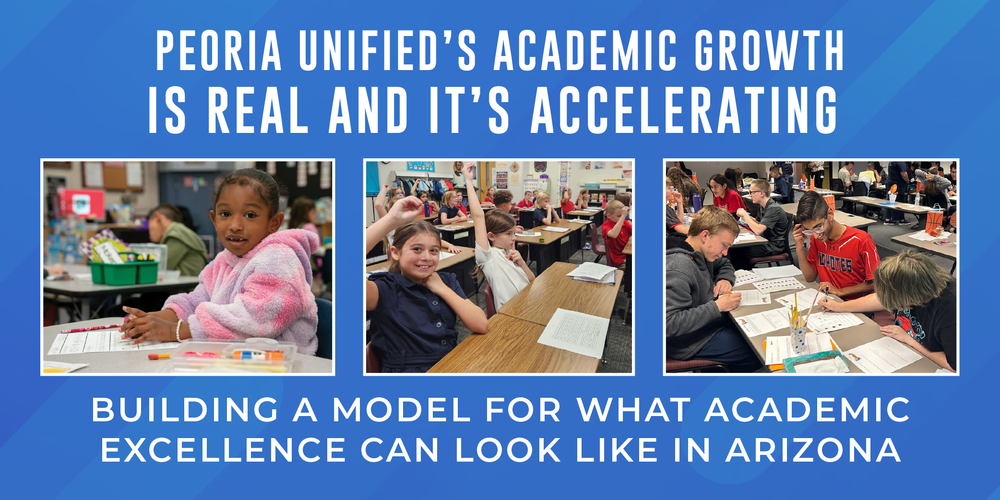
Peoria Unified School District is demonstrating what is possible when a community aligns around one clear goal: Every Student, Every Day, Prepared to Shape Tomorrow. Recently, our educational services team shared updates with the Governing Board related to the academic progress of students across the Peoria Unified School District. This mid-year academic update reveals a story of steady, measurable, and most importantly, intentional progress towards improving academic outcomes.
Across Peoria Unified’s 34 elementary and seven comprehensive high schools, academic growth is taking hold in both English Language Arts (ELA) and Mathematics. Projections based upon assessments show the district is on track to meet and exceed its ambitious goal of a three percent increase in proficiency this school year. In our elementary schools, ELA projections indicate a 1.81‑point rise in proficiency in the fall semester, and math is trending even higher with a projected 3.6‑point jump. High schools are experiencing similar gains, with double‑digit increases in projections for math proficiency and meaningful decreases in the number of students projected to score minimally proficient.
These improvements are not happening by accident. They are the result of strategic changes in curriculum, learning, teaching and support. Peoria Unified has doubled down on quality instruction, strengthened literacy practices aligned to the technical aspects of reading, and implemented new, Governing Board approved, resources supported by continued professional development for teachers. These are not superficial initiatives, but deep, district-wide commitments designed to improve student outcomes over time.
Summer programming has become one of the district’s strongest levers for accelerating achievement. Students most at risk of falling behind are showing statistically significant gains in both reading and math that persist long after summer ends. The district’s acceleration model is working, and its intentional selection of students ensures support goes where it matters most.
Equally noteworthy is the progress among groups identified by the Arizona Department of Education as making less progress than similar students in other districts. Students with disabilities have projected gains of 2.5 percent in ELA and 3.5 percent in math proficiency, mirroring districtwide trends - which is an encouraging sign of instruction that meets the needs of every learner.
Even in schools facing higher levels of poverty and deeper systemic challenges, growth is evident and accelerating. Many of these campuses are now on track to meet performance targets, driven by stronger data analysis, improved instructional alignment and increased collaboration between school leaders and district teams. The number of schools identified for Targeted School Improvement has dropped from 15 to just two.
Peoria Unified’s momentum is the direct result of educators, administrators, families, the community, and Governing Board members who believe students can grow when given the right tools and support. These gains should be celebrated, but not taken for granted. Sustained improvement requires continued investment in strong instruction, high expectations, and evidence-based practices.
Peoria Unified is not just improving; it is building a model for what academic excellence can look like in Arizona. Peoria Unified remains committed to academic transparency- visit www.peoriaunified.org/curriculum to learn more.